Determines length of string of edges walked to point. More...
#include <pointEdgeCollapse.H>
Public Member Functions | |
| pointEdgeCollapse () | |
| Default construct. | |
| pointEdgeCollapse (const point &collapsePoint, const label collapseIndex, const label collapsePriority) | |
| Construct from components. | |
| const point & | collapsePoint () const |
| label | collapseIndex () const |
| label | collapsePriority () const |
| template<class TrackingData> | |
| bool | valid (TrackingData &td) const |
| Changed or contains original (invalid) value. | |
| template<class TrackingData> | |
| void | leaveDomain (const polyPatch &patch, const label patchPointi, const point &pos, TrackingData &td) |
| Convert origin to relative vector to leaving point. | |
| template<class TrackingData> | |
| void | enterDomain (const polyPatch &patch, const label patchPointi, const point &pos, TrackingData &td) |
| Convert relative origin to absolute by adding entering point. | |
| template<class TrackingData> | |
| void | transform (const tensor &rotTensor, TrackingData &td) |
| Apply rotation matrix to origin. | |
| template<class TrackingData> | |
| bool | updatePoint (const polyMesh &mesh, const label pointi, const label edgeI, const pointEdgeCollapse &edgeInfo, const scalar tol, TrackingData &td) |
| Influence of edge on point. | |
| template<class TrackingData> | |
| bool | updatePoint (const polyMesh &mesh, const label pointi, const pointEdgeCollapse &newPointInfo, const scalar tol, TrackingData &td) |
| Influence of different value on same point. | |
| template<class TrackingData> | |
| bool | updatePoint (const pointEdgeCollapse &newPointInfo, const scalar tol, TrackingData &td) |
| Influence of different value on same point. | |
| template<class TrackingData> | |
| bool | updateEdge (const polyMesh &mesh, const label edgeI, const label pointi, const pointEdgeCollapse &pointInfo, const scalar tol, TrackingData &td) |
| Influence of point on edge. | |
| template<class TrackingData> | |
| bool | equal (const pointEdgeCollapse &, TrackingData &) const |
| Test for equality, with TrackingData. | |
| bool | operator== (const pointEdgeCollapse &) const |
| Test for equality. | |
| bool | operator!= (const pointEdgeCollapse &) const |
| Test for inequality. | |
Friends | |
| Ostream & | operator<< (Ostream &, const pointEdgeCollapse &) |
| Istream & | operator>> (Istream &, pointEdgeCollapse &) |
Determines length of string of edges walked to point.
Definition at line 57 of file pointEdgeCollapse.H.
|
inline |
Default construct.
Definition at line 112 of file pointEdgeCollapseI.H.
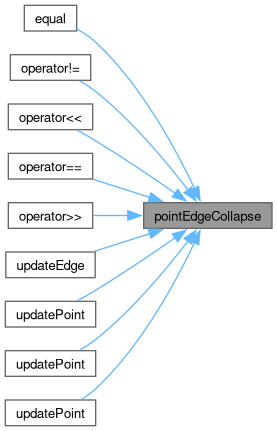
Referenced by equal(), operator!=(), operator<<, operator==(), operator>>, updateEdge(), updatePoint(), updatePoint(), and updatePoint().
|
inline |
Construct from components.
Definition at line 120 of file pointEdgeCollapseI.H.
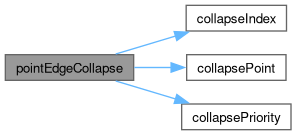
References collapseIndex(), collapsePoint(), and collapsePriority().
|
inline |
Definition at line 119 of file pointEdgeCollapse.H.
Referenced by pointEdgeCollapse().

|
inline |
Definition at line 124 of file pointEdgeCollapse.H.
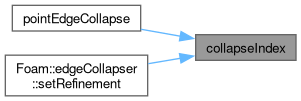
Referenced by pointEdgeCollapse(), and edgeCollapser::setRefinement().
|
inline |
Definition at line 129 of file pointEdgeCollapse.H.
Referenced by pointEdgeCollapse().

|
inline |
Changed or contains original (invalid) value.
Definition at line 136 of file pointEdgeCollapseI.H.
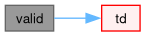
References td().
|
inline |
Convert origin to relative vector to leaving point.
(= point coordinate)
Definition at line 143 of file pointEdgeCollapseI.H.
References td().

|
inline |
Convert relative origin to absolute by adding entering point.
Definition at line 169 of file pointEdgeCollapseI.H.
References td().

|
inline |
Apply rotation matrix to origin.
Definition at line 156 of file pointEdgeCollapseI.H.
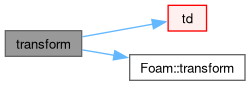
References td(), and Foam::transform().
|
inline |
Influence of edge on point.
Definition at line 184 of file pointEdgeCollapseI.H.
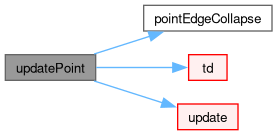
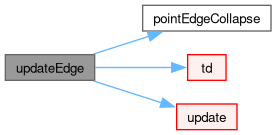
References mesh, pointEdgeCollapse(), td(), and update().
|
inline |
Influence of different value on same point.
Merge new and old info.
Definition at line 200 of file pointEdgeCollapseI.H.
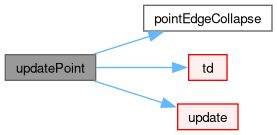
References mesh, pointEdgeCollapse(), td(), and update().
|
inline |
Influence of different value on same point.
No information about current position whatsoever.
Definition at line 215 of file pointEdgeCollapseI.H.
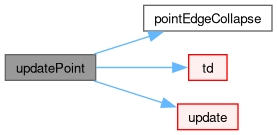
References pointEdgeCollapse(), td(), and update().
|
inline |
Influence of point on edge.
Definition at line 228 of file pointEdgeCollapseI.H.
References mesh, pointEdgeCollapse(), td(), and update().
|
inline |
Test for equality, with TrackingData.
Definition at line 243 of file pointEdgeCollapseI.H.
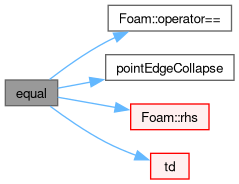
References Foam::operator==(), pointEdgeCollapse(), Foam::rhs(), and td().
|
inline |
Test for equality.
Definition at line 255 of file pointEdgeCollapseI.H.
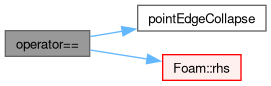
References pointEdgeCollapse(), and Foam::rhs().
|
inline |
Test for inequality.
Definition at line 267 of file pointEdgeCollapseI.H.
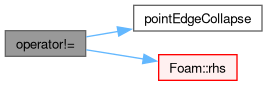
References pointEdgeCollapse(), and Foam::rhs().
|
friend |
References pointEdgeCollapse().
|
friend |
References pointEdgeCollapse().
 1.16.1