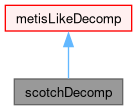
Scotch domain decomposition. More...
#include <scotchDecomp.H>
Public Member Functions | |
| scotchDecomp (const scotchDecomp &)=delete | |
| No copy construct. | |
| void | operator= (const scotchDecomp &)=delete |
| No copy assignment. | |
| TypeName ("scotch") | |
| Runtime type information. | |
| scotchDecomp (const label numDomains) | |
| Construct with number of domains (no coefficients or constraints). | |
| scotchDecomp (const dictionary &decompDict, const word ®ionName="") | |
| Construct given decomposition dictionary and optional region name. | |
| virtual | ~scotchDecomp ()=default |
| Destructor. | |
| virtual bool | parallelAware () const |
| Knows about coupled boundaries. | |
| virtual labelList | decompose (const polyMesh &mesh, const pointField &points=pointField::null(), const scalarField &pointWeights=scalarField::null()) const |
| Return for every coordinate the wanted processor number. | |
| virtual labelList | decompose (const polyMesh &mesh, const labelList &agglom, const pointField &agglomPoints, const scalarField &agglomWeights=scalarField::null()) const |
| Return for every coordinate the wanted processor number. | |
| virtual labelList | decompose (const CompactListList< label > &globalCellCells, const pointField &cc=pointField::null(), const scalarField &cWeights=scalarField::null()) const |
| Return the wanted processor number for every cell. | |
| virtual labelList | decompose (const labelListList &globalCellCells, const pointField &cc=pointField::null(), const scalarField &cWeights=scalarField::null()) const |
| Return the wanted processor number for every cell. | |
| virtual labelList | decompose (const pointField &points, const scalarField &pointWeights=scalarField::null()) const |
| Inherit all decompose methods. | |
| virtual labelList | decompose (const polyMesh &mesh, const scalarField &cellWeights, const boolList &blockedFace, const PtrList< labelList > &specifiedProcessorFaces, const labelList &specifiedProcessor, const List< labelPair > &explicitConnections) const |
| Inherit all decompose methods. | |
| labelList | decompose (const polyMesh &mesh, const scalarField &cWeights) const |
| Inherit all decompose methods. | |
| Public Member Functions inherited from metisLikeDecomp | |
| virtual | ~metisLikeDecomp ()=default |
| Destructor. | |
| labelList | decompose (const polyMesh &mesh, const scalarField &cWeights) const |
| Inherit decompose from decompositionMethod. | |
| Public Member Functions inherited from decompositionMethod | |
| decompositionMethod (const decompositionMethod &)=delete | |
| No copy construct. | |
| void | operator= (const decompositionMethod &)=delete |
| No copy assignment. | |
| TypeName ("decompositionMethod") | |
| Runtime type information. | |
| declareRunTimeSelectionTable (autoPtr, decompositionMethod, dictionary,(const dictionary &decompDict, const word ®ionName),(decompDict, regionName)) | |
| decompositionMethod (const dictionary &decompDict, const word ®ionName="") | |
| Construct given the decomposition dictionary, optionally region-specific. | |
| virtual | ~decompositionMethod ()=default |
| Destructor. | |
| label | nDomains () const noexcept |
| Number of domains. | |
| label | nDomains (const label n) |
| Set number of domains. Return old value. | |
| virtual bool | geometric () const |
| True if the method is purely geometric, often using cell centre points. | |
| void | setConstraints (const polyMesh &mesh, boolList &blockedFace, PtrList< labelList > &specifiedProcessorFaces, labelList &specifiedProcessor, List< labelPair > &explicitConnections) const |
| Helper: extract constraints: | |
| void | applyConstraints (const polyMesh &mesh, const boolList &blockedFace, const PtrList< labelList > &specifiedProcessorFaces, const labelList &specifiedProcessor, const List< labelPair > &explicitConnections, labelList &finalDecomp) const |
| Helper: apply constraints to a decomposition. | |
| labelList | decompose (const polyMesh &mesh, const scalarField &cWeights) const |
| Decompose a mesh. | |
Protected Member Functions | |
| virtual label | decomposeSerial (const labelList &adjncy, const labelList &xadj, const List< scalar > &cWeights, labelList &decomp) const |
| Decompose non-parallel. | |
| Protected Member Functions inherited from metisLikeDecomp | |
| virtual label | decomposeGeneral (const labelList &adjncy, const labelList &xadj, const List< scalar > &cellWeights, labelList &decomp) const |
| Serial and/or collect/distribute for parallel operation. | |
| metisLikeDecomp (const metisLikeDecomp &)=delete | |
| No copy construct. | |
| void | operator= (const metisLikeDecomp &)=delete |
| No copy assignment. | |
| metisLikeDecomp (const label numDomains) | |
| Construct with number of domains (no coefficients or constraints). | |
| metisLikeDecomp (const word &derivedType, const dictionary &decompDict, int select=selectionType::NULL_DICT) | |
| Construct for derived type name and decomposition dictionary. | |
| metisLikeDecomp (const word &derivedType, const dictionary &decompDict, const word ®ionName, int select=selectionType::NULL_DICT) | |
| Construct for derived type name, decomposition dictionary and (optional) region name. | |
| Protected Member Functions inherited from decompositionMethod | |
| FOAM_NO_DANGLING_REFERENCE const dictionary & | findCoeffsDict (const word &coeffsName, int select=selectionType::DEFAULT) const |
| Locate coeffsName dictionary or the fallback "coeffs" dictionary. | |
| decompositionMethod (const label numDomains) | |
| Construct with specified number of domains, no coefficients or constraints. | |
Additional Inherited Members | |
| Static Public Member Functions inherited from decompositionMethod | |
| static label | nDomains (const dictionary &decompDict, const word ®ionName="") |
Return region-specific or top-level numberOfSubdomains entry. | |
| static const dictionary & | optionalRegionDict (const dictionary &decompDict, const word ®ionName) |
| Return an optional region-specific dictionary from "regions" sub-dictionary, or dictionary::null on failure. | |
| static autoPtr< decompositionMethod > | New (const dictionary &decompDict, const word ®ionName="") |
| Return a reference to the selected decomposition method, optionally region-specific. | |
| static void | calcCellCells (const polyMesh &mesh, const labelList &agglom, const label nLocalCoarse, const bool parallel, CompactListList< label > &cellCells) |
| Determine (local or global) cellCells from mesh agglomeration. | |
| static void | calcCellCells (const polyMesh &mesh, const labelList &agglom, const label nLocalCoarse, const bool parallel, CompactListList< label > &cellCells, CompactListList< scalar > &cellCellWeights) |
| Determine (local or global) cellCells and face weights from mesh agglomeration. | |
| Protected Types inherited from decompositionMethod | |
| enum | selectionType { DEFAULT = 0 , EXACT = 1 , MANDATORY = 2 , NULL_DICT = 4 } |
| Selection type when handling the coefficients dictionary. More... | |
| Static Protected Member Functions inherited from decompositionMethod | |
| static FOAM_NO_DANGLING_REFERENCE const dictionary & | findCoeffsDict (const dictionary &dict, const word &coeffsName, int select=selectionType::DEFAULT) |
| Locate coeffsName dictionary or the fallback "coeffs" dictionary within an enclosing dictionary. | |
| Protected Attributes inherited from metisLikeDecomp | |
| const dictionary & | coeffsDict_ |
| Coefficients for all derived methods. | |
| Protected Attributes inherited from decompositionMethod | |
| const dictionary & | decompDict_ |
| Top-level decomposition dictionary (eg, decomposeParDict). | |
| const dictionary & | decompRegionDict_ |
| Region-specific decomposition dictionary information. | |
| label | nDomains_ |
| Number of domains for the decomposition. | |
| PtrList< decompositionConstraint > | constraints_ |
| Optional constraints. | |
Scotch domain decomposition.
When run in parallel will collect the whole graph on to the master, decompose and send back. Use ptscotchDecomp for proper distributed decomposition.
Coefficients dictionary: scotchCoeffs, coeffs.
Quoting from the Scotch forum, on the 2008-08-22 10:09, Francois PELLEGRINI posted the following details:
RE: Graph mapping 'strategy' string

Strategy handling in Scotch is a bit tricky. In order
not to be confused, you must have a clear view of how they are built.
Here are some rules:

1- Strategies are made up of "methods" which are combined by means of
"operators".

2- A method is of the form "m{param=value,param=value,...}", where "m"
is a single character (this is your first error: "f" is a method name,
not a parameter name).

3- There exist different sort of strategies : bipartitioning strategies,
mapping strategies, ordering strategies, which cannot be mixed. For
instance, you cannot build a bipartitioning strategy and feed it to a
mapping method (this is your second error).

To use the "mapCompute" routine, you must create a mapping strategy, not
a bipartitioning one, and so use stratGraphMap() and not
stratGraphBipart(). Your mapping strategy should however be based on the
"recursive bipartitioning" method ("b"). For instance, a simple (and
hence not very efficient) mapping strategy can be :

"b{sep=f}"

which computes mappings with the recursive bipartitioning method "b",
this latter using the Fiduccia-Mattheyses method "f" to compute its
separators.

If you want an exact partition (see your previous post), try
"b{sep=fx}".

However, these strategies are not the most efficient, as they do not
make use of the multi-level framework.

To use the multi-level framework, try for instance:

"b{sep=m{vert=100,low=h,asc=f}x}"

The current default mapping strategy in Scotch can be seen by using the
"-vs" option of program gmap. It is, to date:

r
{
    job=t,
    map=t,
    poli=S,
    sep=
    (
        m
        {
            asc=b
            {
                bnd=
                (
                    d{pass=40,dif=1,rem=1}
                 |
                )
                f{move=80,pass=-1,bal=0.002491},
                org=f{move=80,pass=-1,bal=0.002491},
                width=3
            },
            low=h{pass=10}
            f{move=80,pass=-1,bal=0.002491},
            type=h,
            vert=80,
            rat=0.8
        }
      | m
        {
            asc=b
            {
                bnd=
                (
                    d{pass=40,dif=1,rem=1}
                  |
                )
                f{move=80,pass=-1,bal=0.002491},
                org=f{move=80,pass=-1,bal=0.002491},
                width=3
            },
            low=h{pass=10}
            f{move=80,pass=-1,bal=0.002491},
            type=h,
            vert=80,
            rat=0.8
        }
    )
}
Given that this information was written in 2008, this example strategy will unlikely work as-is with the more recent Scotch versions. Therefore, the steps for getting the current default strategy from within Scotch, is to do the following steps:
Edit the file system/decomposeParDict and use the following settings:
method          scotch;

scotchCoeffs
{
    writeGraph true;
}
Run decomposePar. For example, it will write a file named region0.grf.
Now, instead of using gmap, run gpart with the following command structure to get the default strategy:
gpart \<nProcs\> -vs \<grfFile\>
where:
numberOfSubdomains defined in the dictionary file. At the end of the execution will be shown a long string, similar to the following example (complete line was cropped at [...]):
S Strat=m{asc=b{width=3,bnd=d{pass=40,dif=1,rem=0}[...],type=h}
Edit the file system/decomposeParDict once again and add the strategy entry as exemplified:
method          scotch;

scotchCoeffs
{
    //writeGraph true;
    strategy "m{asc=b{width=3,bnd=d{pass=40,dif=1,rem=0}[...],type=h}";
}
Finally, run decomposePar once again, to at least test if it works as intended.
Also support for multi-level decomposition by specifying inter-level communication weights:
numberOfSubdomains  2048;
coeffs
{
    // Divide into 64 clusters, each of 32 cores
    domains (64 32);
    // Inside a cluster the communication weight is 1% of that inbetween
    // clusters
    domainWeights (1 0.01);
}
Alternatively the first-level decomposition can be left out by assuming weights are 1 for that level:
numberOfSubdomains  2048;
coeffs
{
    // Divide into 2048/32 clusters
    domains (32);
    // Inside a cluster the communication weight is 1% of that inbetween
    // clusters
    domainWeights (0.01);
}
gpart can be found in the current search path by adding the respective bin folder from the Scotch installation, namely by running the following commands:source $(foamEtcFile config.sh/scotch) export PATH=$PATH:$SCOTCH_ARCH_PATH/bin
Definition at line 259 of file scotchDecomp.H.
|
delete |
No copy construct.
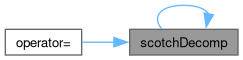
References scotchDecomp().
Referenced by operator=(), and scotchDecomp().
|
explicit |
Construct with number of domains (no coefficients or constraints).
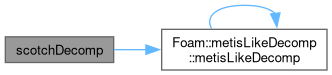
Definition at line 520 of file scotchDecomp.C.
References metisLikeDecomp::metisLikeDecomp().
|
explicit |
Construct given decomposition dictionary and optional region name.
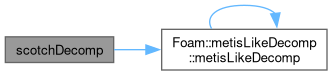
Definition at line 526 of file scotchDecomp.C.
References Foam::GlobalIOList< Tuple2< scalar, vector > >::typeName, metisLikeDecomp::metisLikeDecomp(), decompositionMethod::NULL_DICT, and regionName.
|
virtualdefault |
Destructor.
|
protectedvirtual |
Decompose non-parallel.
Hack to test clustering. Note that decomp is non-compact
numbers!
//- Set up variable sizes architecture check ( SCOTCH_archVcmplt(&archdat), "SCOTCH_archVcmplt" );
//- Stategy flags: go for quality or load balance (or leave default) SCOTCH_Num straval = 0; //straval |= SCOTCH_STRATQUALITY; //straval |= SCOTCH_STRATQUALITY;
//- Number of cells per agglomeration //SCOTCH_Num agglomSize = SCOTCH_archSize(&archdat); SCOTCH_Num agglomSize = 3;
//- Build strategy for agglomeration check ( SCOTCH_stratGraphClusterBuild ( &stradat, // strategy to build straval, // strategy flags agglomSize, // cells per cluster 1.0, // weight? 0.01 // max load imbalance ), "SCOTCH_stratGraphClusterBuild" );
Implements metisLikeDecomp.
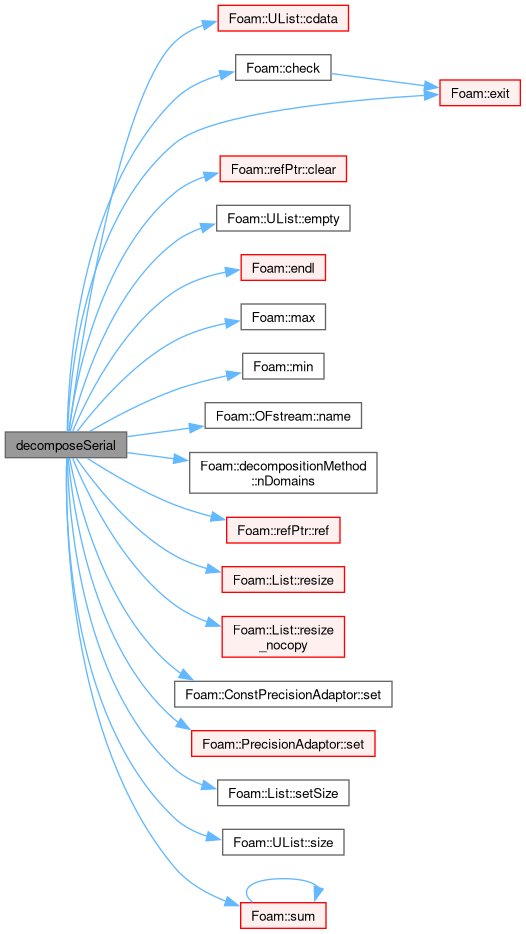
Definition at line 101 of file scotchDecomp.C.
References UList< T >::cdata(), Foam::check(), refPtr< T >::clear(), metisLikeDecomp::coeffsDict_, DebugInfo, UList< T >::empty(), Foam::endl(), Foam::exit(), Foam::FatalError, FatalErrorInFunction, Foam::FatalIOError, FatalIOErrorInFunction, forAll, Foam::Info, keyType::LITERAL, Foam::max(), Foam::min(), n, OFstream::name(), decompositionMethod::nDomains(), decompositionMethod::nDomains_, Foam::nl, refPtr< T >::ref(), List< T >::resize(), List< T >::resize_nocopy(), ConstPrecisionAdaptor< Type, InputType, Container >::set(), PrecisionAdaptor< Type, InputType, Container >::set(), List< T >::setSize(), UList< T >::size(), Foam::sum(), and WarningInFunction.
|
delete |
| TypeName | ( | "scotch" | ) |
Runtime type information.
References regionName.
|
inlinevirtual |
Knows about coupled boundaries.
Implements decompositionMethod.
Definition at line 335 of file scotchDecomp.H.
|
virtual |
Return for every coordinate the wanted processor number.
Reimplemented from metisLikeDecomp.
Definition at line 538 of file scotchDecomp.C.
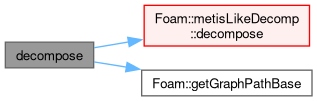
References metisLikeDecomp::decompose(), Foam::getGraphPathBase(), mesh, and points.
|
virtual |
Return for every coordinate the wanted processor number.
| agglom | agglomeration: fine-to-coarse |
Reimplemented from metisLikeDecomp.
Definition at line 557 of file scotchDecomp.C.
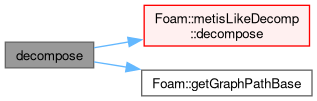
References metisLikeDecomp::decompose(), Foam::getGraphPathBase(), and mesh.
|
virtual |
Return the wanted processor number for every cell.
Reimplemented from metisLikeDecomp.
Definition at line 578 of file scotchDecomp.C.
References metisLikeDecomp::decompose().

|
virtual |
Return the wanted processor number for every cell.
Reimplemented from metisLikeDecomp.
Definition at line 597 of file scotchDecomp.C.
References metisLikeDecomp::decompose().

|
virtual |
Inherit all decompose methods.
Reimplemented from metisLikeDecomp.
Definition at line 298 of file decompositionMethod.C.
|
virtual |
Inherit all decompose methods.
| blockedFace | Whether owner and neighbour should be on same processor |
(takes priority over explicitConnections)
| specifiedProcessorFaces | Whether whole sets of faces (and point neighbours) need to be kept |
on single processor
| explicitConnections | Additional connections between boundary faces |
Reimplemented from metisLikeDecomp.
Definition at line 422 of file decompositionMethod.C.
| Foam::labelList decompose | ( | const polyMesh & | mesh, |
| const scalarField & | cWeights ) const |
Inherit all decompose methods.
Definition at line 445 of file decompositionMethod.C.
 1.16.1