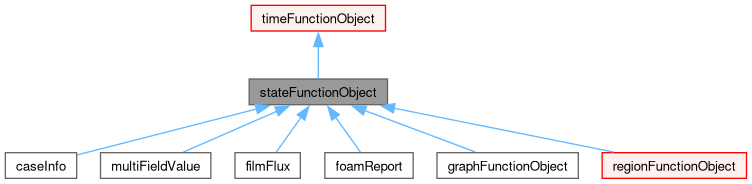
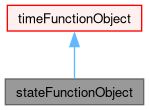
Base class for function objects, adding functionality to read/write state information (data required for smooth restart behaviour) and results to/from the state dictionary. More...
#include <stateFunctionObject.H>
Public Member Functions | |
| stateFunctionObject (const word &name, const Time &runTime) | |
| Construct from components. | |
| virtual | ~stateFunctionObject ()=default |
| Destructor. | |
| dictionary & | propertyDict () |
| Return access to the property dictionary. | |
| bool | foundProperty (const word &entryName) const |
| Return true if the property exists. | |
| void | clearTrigger () |
| Remove the trigger index from the properties. | |
| label | getTrigger () const |
| Get the current trigger index. | |
| bool | setTrigger (const label triggeri) |
| Set new trigger index. | |
| bool | getDict (const word &entryName, dictionary &dict) const |
| Set dictionary, return true if set. | |
| bool | getObjectDict (const word &objectName, const word &entryName, dictionary &dict) const |
| Set dictionary from named object, return true if set. | |
| template<class Type> | |
| Type | getProperty (const word &entryName, const Type &defaultValue=Type(Zero)) const |
| Retrieve generic property. | |
| template<class Type> | |
| bool | getProperty (const word &entryName, Type &value) const |
| Set generic property, return true if set. | |
| template<class Type> | |
| void | setProperty (const word &entryName, const Type &value) |
| Add generic property. | |
| template<class Type> | |
| Type | getObjectProperty (const word &objectName, const word &entryName, const Type &defaultValue=Type(Zero)) const |
| Retrieve generic property from named object. | |
| template<class Type> | |
| bool | getObjectProperty (const word &objectName, const word &entryName, Type &value) const |
| Set generic property from named object, return true if set. | |
| template<class Type> | |
| void | setObjectProperty (const word &objectName, const word &entryName, const Type &value) |
| Add generic property from named object. | |
| bool | getObjectResultDict (const word &objectName, dictionary &dict) const |
| template<class Type> | |
| void | setResult (const word &entryName, const Type &value) |
| Add result. | |
| template<class Type> | |
| void | setObjectResult (const word &objectName, const word &entryName, const Type &value) |
| Add result from named object. | |
| template<class Type> | |
| Type | getResult (const word &entryName, const Type &defaultValue=Type(Zero)) const |
| Retrieve result. | |
| template<class Type> | |
| Type | getObjectResult (const word &objectName, const word &entryName, const Type &defaultValue=Type(Zero)) const |
| Retrieve result from named object. | |
| template<class Type> | |
| bool | getObjectResult (const word &objectName, const word &entryName, Type &value) const |
| Set result from named object, return true if set. | |
| word | resultType (const word &entryName) const |
| Retrieve the result type. | |
| word | objectResultType (const word &objectName, const word &entryName) const |
| Return the type of result. | |
| wordList | objectResultEntries () const |
| Retrieve the result entries. | |
| wordList | objectResultEntries (const word &objectName) const |
| Return result entries for named object. | |
| void | writeResultEntries (Ostream &os) const |
| Write the results entries for all objects to stream. | |
| void | writeResultEntries (const word &objectName, Ostream &os) const |
| Write the results entries for named object to stream. | |
| void | writeAllResultEntries (Ostream &os) const |
| Write the results entries for all objects to stream. | |
| Public Member Functions inherited from timeFunctionObject | |
| timeFunctionObject (const word &name, const Time &runTime) | |
| Construct from Time. | |
| virtual | ~timeFunctionObject ()=default |
| Destructor. | |
| const Time & | time () const |
| Return time database. | |
| objectRegistry & | storedObjects () |
| Write access to the output objects ("functionObjectObjects") registered on Time. | |
| const objectRegistry & | storedObjects () const |
| Const access to the output objects ("functionObjectObjects") registered on Time. | |
| Public Member Functions inherited from functionObject | |
| declareRunTimeSelectionTable (autoPtr, functionObject, dictionary,(const word &name, const Time &runTime, const dictionary &dict),(name, runTime, dict)) | |
| functionObject (const word &name, const bool withNamePrefix=defaultUseNamePrefix) | |
| Construct from components. | |
| autoPtr< functionObject > | clone () const |
| Return clone. | |
| virtual | ~functionObject ()=default |
| Destructor. | |
| virtual const word & | type () const =0 |
| Runtime type information. | |
| const word & | name () const noexcept |
| Return the name of this functionObject. | |
| bool | useNamePrefix () const noexcept |
| Return the flag for adding a scoping name prefix. | |
| bool | useNamePrefix (bool on) noexcept |
| Modify the flag for adding a scoping name prefix. | |
| virtual bool | read (const dictionary &dict) |
| Read and set the function object if its data have changed. | |
| virtual bool | execute ()=0 |
| Called at each ++ or += of the time-loop. | |
| virtual bool | execute (const label subIndex) |
| Execute using the specified subIndex. | |
| virtual bool | write ()=0 |
| Called at each ++ or += of the time-loop. | |
| virtual bool | end () |
| Called when Time::run() determines that the time-loop exits. | |
| virtual bool | adjustTimeStep () |
| Called at the end of Time::adjustDeltaT() if adjustTime is true. | |
| virtual bool | filesModified () const |
| Did any file get changed during execution? | |
| virtual void | updateMesh (const mapPolyMesh &mpm) |
| Update for changes of mesh. | |
| virtual void | movePoints (const polyMesh &mesh) |
| Update for changes of mesh. | |
Protected Member Functions | |
| const functionObjects::properties & | stateDict () const |
| Return a const reference to the state dictionary. | |
| functionObjects::properties & | stateDict () |
| Return non-const access to the state dictionary. | |
| stateFunctionObject (const stateFunctionObject &)=delete | |
| No copy construct. | |
| void | operator= (const stateFunctionObject &)=delete |
| No copy assignment. | |
| Protected Member Functions inherited from timeFunctionObject | |
| void | clearOutputObjects (const wordList &objNames) |
| Remove specified items from "functionObjectObjects". | |
| timeFunctionObject (const timeFunctionObject &)=delete | |
| No copy construct. | |
| void | operator= (const timeFunctionObject &)=delete |
| No copy assignment. | |
| Protected Member Functions inherited from functionObject | |
| word | scopedName (const word &name) const |
| Return a scoped (prefixed) name. | |
Additional Inherited Members | |
| Static Public Member Functions inherited from functionObject | |
| static autoPtr< functionObject > | New (const word &name, const Time &runTime, const dictionary &dict) |
| Select from dictionary, based on its "type" entry. | |
| Public Attributes inherited from functionObject | |
| bool | log |
| Flag to write log into Info. | |
| Static Public Attributes inherited from functionObject | |
| static int | debug |
| Flag to execute debug content. | |
| static bool | postProcess |
| Global post-processing mode switch. | |
| static bool | defaultUseNamePrefix |
| Global default for useNamePrefix. | |
| static word | outputPrefix |
| Directory prefix. | |
| Protected Attributes inherited from timeFunctionObject | |
| const Time & | time_ |
| Reference to the time database. | |
Base class for function objects, adding functionality to read/write state information (data required for smooth restart behaviour) and results to/from the state dictionary.
Note: cannot access the state dictionary until after construction of the function objects, since the owner container functionObjectList is owned by time, and time owns the state dictionary i.e. need to wait for time to be fully constructed.
Definition at line 65 of file stateFunctionObject.H.
|
protecteddelete |
No copy construct.
References stateFunctionObject().
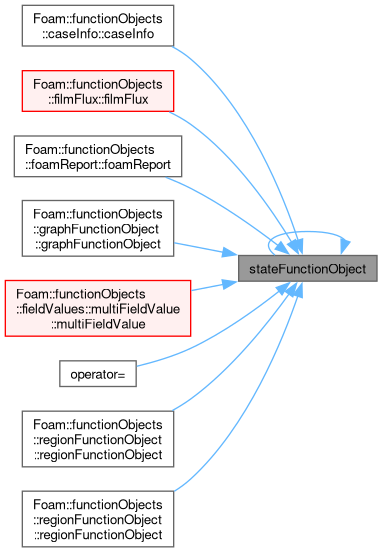
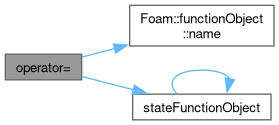
Referenced by caseInfo::caseInfo(), filmFlux::filmFlux(), foamReport::foamReport(), graphFunctionObject::graphFunctionObject(), multiFieldValue::multiFieldValue(), operator=(), regionFunctionObject::regionFunctionObject(), regionFunctionObject::regionFunctionObject(), and stateFunctionObject().
Construct from components.
Definition at line 52 of file stateFunctionObject.C.
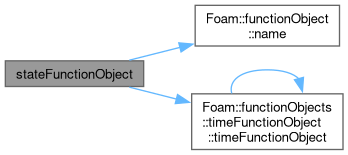
References functionObject::name(), runTime, and timeFunctionObject::timeFunctionObject().
|
virtualdefault |
|
protected |
Return a const reference to the state dictionary.
Definition at line 34 of file stateFunctionObject.C.
References timeFunctionObject::time_.
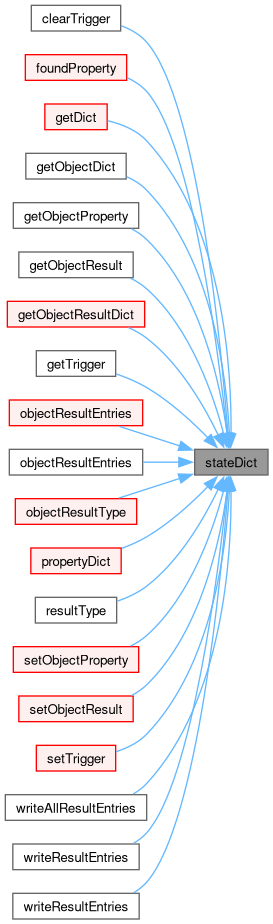
Referenced by clearTrigger(), foundProperty(), getDict(), getObjectDict(), getObjectProperty(), getObjectResult(), getObjectResultDict(), getTrigger(), objectResultEntries(), objectResultEntries(), objectResultType(), propertyDict(), resultType(), setObjectProperty(), setObjectResult(), setTrigger(), writeAllResultEntries(), writeResultEntries(), and writeResultEntries().
|
protected |
Return non-const access to the state dictionary.
Definition at line 41 of file stateFunctionObject.C.
References propsDict(), and timeFunctionObject::time_.

|
protecteddelete |
No copy assignment.
References functionObject::name(), runTime, and stateFunctionObject().
| Foam::dictionary & propertyDict | ( | ) |
Return access to the property dictionary.
Definition at line 64 of file stateFunctionObject.C.
References name, and stateDict().
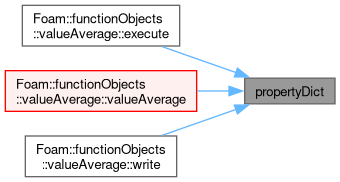
Referenced by valueAverage::execute(), valueAverage::valueAverage(), and valueAverage::write().

| bool foundProperty | ( | const word & | entryName | ) | const |
Return true if the property exists.
Definition at line 91 of file stateFunctionObject.C.
References name, and stateDict().
Referenced by fieldAverage::readAveragingProperties().


| void clearTrigger | ( | ) |
Remove the trigger index from the properties.
Definition at line 70 of file stateFunctionObject.C.
References stateDict().

| Foam::label getTrigger | ( | ) | const |
Get the current trigger index.
Definition at line 76 of file stateFunctionObject.C.
References stateDict().

| bool setTrigger | ( | const label | triggeri | ) |
Set new trigger index.
Definition at line 82 of file stateFunctionObject.C.
References stateDict().
Referenced by runTimeControl::execute().


| bool getDict | ( | const word & | entryName, |
| dictionary & | dict ) const |
Set dictionary, return true if set.
Definition at line 100 of file stateFunctionObject.C.
References dict, name, and stateDict().
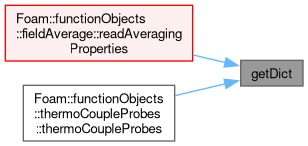
Referenced by fieldAverage::readAveragingProperties(), and thermoCoupleProbes::thermoCoupleProbes().

| bool getObjectDict | ( | const word & | objectName, |
| const word & | entryName, | ||
| dictionary & | dict ) const |
Set dictionary from named object, return true if set.
Definition at line 110 of file stateFunctionObject.C.
References dict, and stateDict().

| Type getProperty | ( | const word & | entryName, |
| const Type & | defaultValue = Type(Zero) ) const |
Retrieve generic property.
Definition at line 27 of file stateFunctionObjectTemplates.C.
References getProperty().
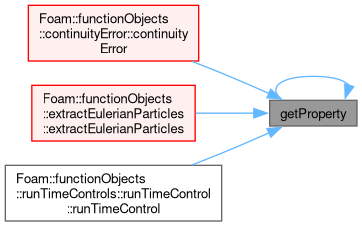
Referenced by continuityError::continuityError(), extractEulerianParticles::extractEulerianParticles(), getProperty(), and runTimeControl::runTimeControl().

| bool getProperty | ( | const word & | entryName, |
| Type & | value ) const |
Set generic property, return true if set.
Definition at line 40 of file stateFunctionObjectTemplates.C.
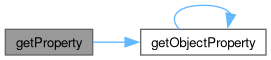
References getObjectProperty(), and name.
| void setProperty | ( | const word & | entryName, |
| const Type & | value ) |
Add generic property.
Definition at line 51 of file stateFunctionObjectTemplates.C.
References name, and setObjectProperty().
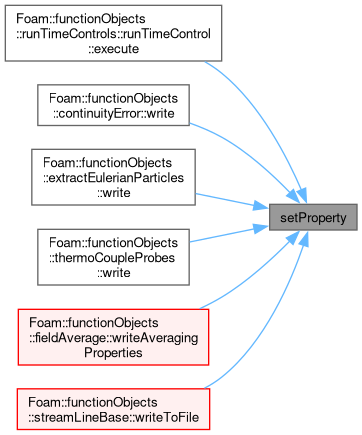
Referenced by runTimeControl::execute(), continuityError::write(), extractEulerianParticles::write(), thermoCoupleProbes::write(), fieldAverage::writeAveragingProperties(), and streamLineBase::writeToFile().

| Type getObjectProperty | ( | const word & | objectName, |
| const word & | entryName, | ||
| const Type & | defaultValue = Type(Zero) ) const |
Retrieve generic property from named object.
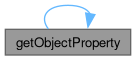
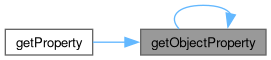
Definition at line 62 of file stateFunctionObjectTemplates.C.
References getObjectProperty().
Referenced by getObjectProperty(), and getProperty().
| bool getObjectProperty | ( | const word & | objectName, |
| const word & | entryName, | ||
| Type & | value ) const |
Set generic property from named object, return true if set.
Definition at line 76 of file stateFunctionObjectTemplates.C.
References stateDict().

| void setObjectProperty | ( | const word & | objectName, |
| const word & | entryName, | ||
| const Type & | value ) |
Add generic property from named object.
Definition at line 88 of file stateFunctionObjectTemplates.C.
References stateDict().
Referenced by setProperty().


| bool getObjectResultDict | ( | const word & | objectName, |
| dictionary & | dict ) const |
Definition at line 121 of file stateFunctionObject.C.
References dict, and stateDict().
Referenced by caseInfo::writeFunctionObjects().


| void setResult | ( | const word & | entryName, |
| const Type & | value ) |
Add result.
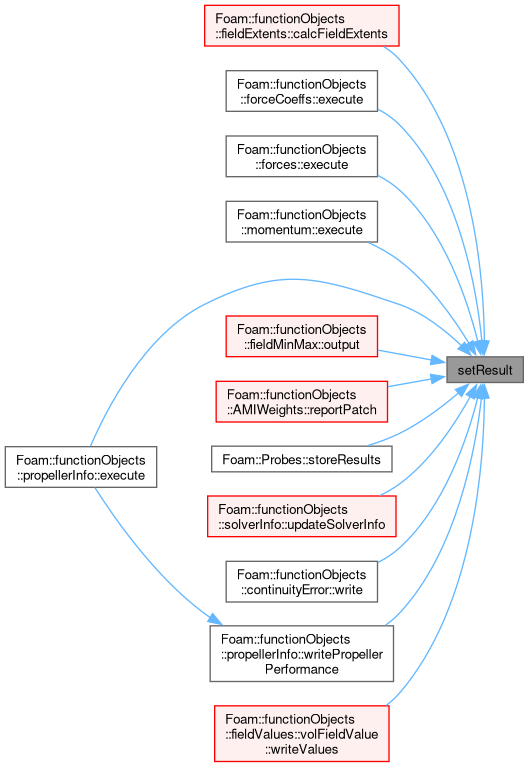
Definition at line 100 of file stateFunctionObjectTemplates.C.
References name, and setObjectResult().
Referenced by fieldExtents::calcFieldExtents(), forceCoeffs::execute(), forces::execute(), momentum::execute(), propellerInfo::execute(), fieldMinMax::output(), AMIWeights::reportPatch(), Probes< ProbeType >::storeResults(), solverInfo::updateSolverInfo(), continuityError::write(), propellerInfo::writePropellerPerformance(), and volFieldValue::writeValues().

| void setObjectResult | ( | const word & | objectName, |
| const word & | entryName, | ||
| const Type & | value ) |
Add result from named object.
Definition at line 111 of file stateFunctionObjectTemplates.C.
References stateDict().
Referenced by setResult().


| Type getResult | ( | const word & | entryName, |
| const Type & | defaultValue = Type(Zero) ) const |
Retrieve result.
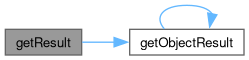
Definition at line 123 of file stateFunctionObjectTemplates.C.
References getObjectResult(), and name.
| Type getObjectResult | ( | const word & | objectName, |
| const word & | entryName, | ||
| const Type & | defaultValue = Type(Zero) ) const |
Retrieve result from named object.
Definition at line 134 of file stateFunctionObjectTemplates.C.
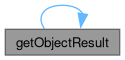
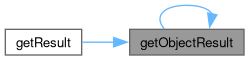
References getObjectResult().
Referenced by getObjectResult(), and getResult().
| bool getObjectResult | ( | const word & | objectName, |
| const word & | entryName, | ||
| Type & | value ) const |
Set result from named object, return true if set.
Definition at line 148 of file stateFunctionObjectTemplates.C.
References stateDict().

| Foam::word resultType | ( | const word & | entryName | ) | const |
Retrieve the result type.
Definition at line 131 of file stateFunctionObject.C.
References name, and stateDict().

| Foam::word objectResultType | ( | const word & | objectName, |
| const word & | entryName ) const |
Return the type of result.
Definition at line 140 of file stateFunctionObject.C.
References stateDict().
Referenced by multiFieldValue::write().


| Foam::wordList objectResultEntries | ( | ) | const |
Retrieve the result entries.
Definition at line 151 of file stateFunctionObject.C.
References name, and stateDict().
Referenced by multiFieldValue::write().


| Foam::wordList objectResultEntries | ( | const word & | objectName | ) | const |
Return result entries for named object.
Definition at line 158 of file stateFunctionObject.C.
References stateDict().

| void writeResultEntries | ( | Ostream & | os | ) | const |
Write the results entries for all objects to stream.
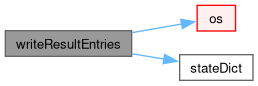
Definition at line 167 of file stateFunctionObject.C.
References name, os(), and stateDict().
Write the results entries for named object to stream.
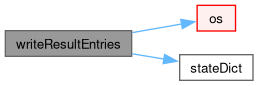
Definition at line 176 of file stateFunctionObject.C.
References os(), and stateDict().
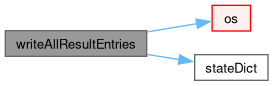
| void writeAllResultEntries | ( | Ostream & | os | ) | const |
Write the results entries for all objects to stream.
Definition at line 186 of file stateFunctionObject.C.
References os(), and stateDict().
 1.16.1
